


Made In America: Announcing Our Investment In Eagle Electronics
Much has been made in recent years of the growing complexity surrounding U.S. -
Why we led the Series A in an AI-native HVAC marketplace — and what it says about where we think the next decade of value creation is hiding.
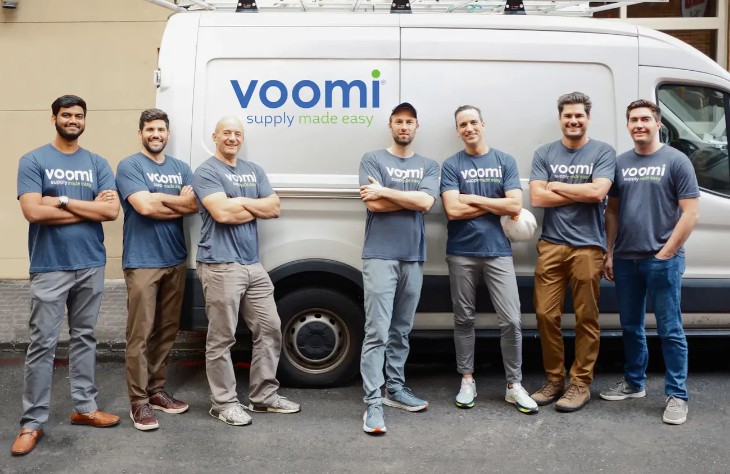
We are thrilled to announce that Asymmetric Capital Partners led the Series A in Voomi Supply, the AI-native marketplace for HVAC parts and equipment. Voomi is building the infrastructure that brings one of America's largest and most operationally critical industries online for the first time, and we’re thrilled to add it to our Fund II portfolio.
Voomi falls squarely into a category of opportunity that continues to define part of our investment strategy: the AI-driven transformation of large, fragmented, brick-and-mortar industries that the internet largely left behind.
Conventional wisdom holds that e-commerce has already disrupted retail, supply chain, and distribution. Referencing sci-fi author William Gibson’s chestnut: “The future is already here – it's just not evenly distributed”. In reality, the disruption has been remarkably shallow, especially in b2b. Amazon and its peers transformed the buying experience for standardized, easily described consumer goods. But the vast majority of commercial transactions still happen by phone call, personal relationship, and institutional memory: contractor to supplier, distributor to manufacturer, tradesperson to parts counter.
This is not a failure of ambition on the part of those industries. It reflects genuine structural complexity. HVAC moves approximately $100 billion in parts and equipment annually in the United States. Despite that scale, e-commerce penetration has been negligible. Supply is scattered across thousands of regional distributors; original equipment manufacturers guard their channels closely; product catalogs exist in formats that make accurate online search nearly impossible; and the cost of delivering a wrong part to a contractor mid-job is catastrophically high in terms of customer relationships and lost labor time.
What kept HVAC offline was more nuanced than standard legacy industry inertia. Cleaning, standardizing, and accurately matching millions of SKUs across thousands of fragmented suppliers — a problem of unstructured data at extraordinary scale — demanded human expertise at a cost structure that made online marketplaces unviable.
HVAC is not unique in this regard. The same structural dynamic characterizes dozens of other large physical markets: commercial foodservice equipment, industrial maintenance and repair, building materials, agricultural inputs, medical devices and disposables. Each has its own version of the same problem: a long tail of SKUs, fragmented regional supply, and a data quality challenge that historically required expensive human intermediaries to navigate.
Modern AI has made it economically viable, for the first time, to clean and standardize messy product catalogs at scale, surface the right part from the right distributor in the right geography in an instantaneous query, and translate institutional knowledge that previously lived in the heads of experienced sales reps into an always-available system.
This is not a marginal improvement on the status quo. It is a structural shift in the unit economics of operating a marketplace in fragmented, high-SKU-count industries. Processes that previously required phone calls, relationship capital, and institutional memory can now be collapsed into a software prompt. That shift changes the competitive calculus entirely.
Several converging forces are accelerating the transition. Private equity ownership of physical-economy businesses has deepened dramatically over the past decade, across HVAC contractors, plumbing and electrical service companies, building product distributors, and many adjacent categories. PE-backed operators are far more likely to demand digital procurement tools, spend analytics, and inventory optimization software than their owner-operated predecessors. Meanwhile, generative AI is raising the stakes for data quality: companies that have invested in building proprietary, clean, structured data assets will see those assets appreciate as AI capabilities improve. And succession pressure among aging distributor and dealer networks is creating partnership and acquisition opportunities that simply did not exist five years ago.
We were introduced to Voomi through our ongoing deal flow relationship with Operator Partners, who provided the company's initial $2 million of outside growth capital relatively late in the journey after the company was bootstrapped for many years. What compelled us was not the market size alone, though a $100 billion industry with negligible e-commerce penetration is a compelling starting point. It was the evidence that Voomi had identified and was solving the right problem.
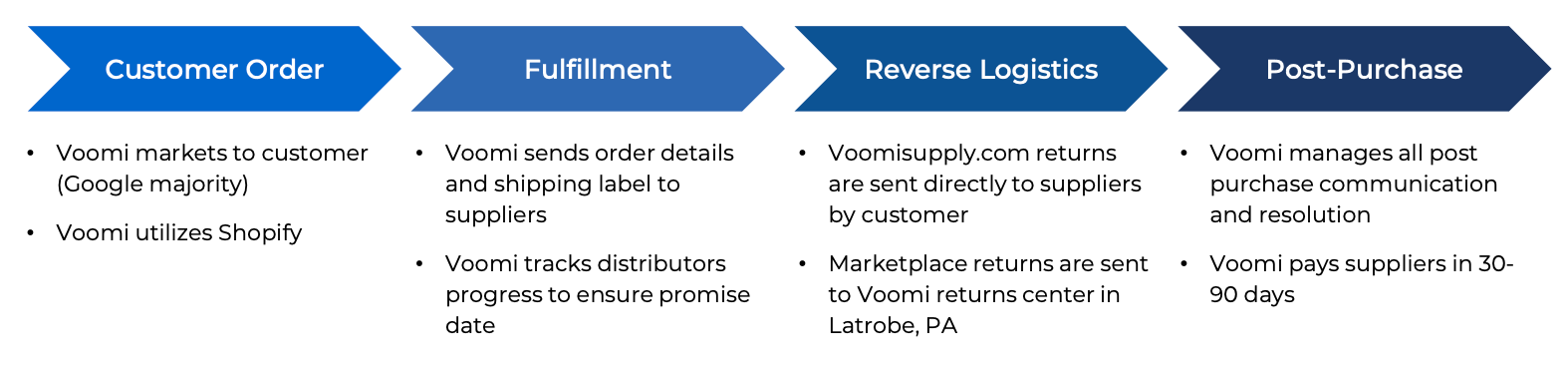
The company has spent years building the data infrastructure that makes accurate, reliable parts matching possible at scale. That is the unglamorous, technically demanding work that creates durable competitive moats. The result is a 108% revenue CAGR from 2021 to 2025, with growth continuing to roughly double annually as the business has scaled. This combination of strong growth and capital efficiency is the signature of a business that has found genuine product-market fit rather than one that is simply buying growth.
The customer base is equally telling. Voomi's accounts include NASA, Columbia University, the USPS, and Stanford University — organizations with professional procurement functions that evaluated alternatives and chose Voomi. The customers exhibit LTV/CAC ratios that reflect genuine switching costs, not promotional acquisition. When a procurement team at a large institution integrates Voomi into its purchasing workflow, that relationship is sticky.
Voomi's co-founders previously built SimpleTire, an asset-light, negative working capital online tire distributor that reached a nine-figure outcome. They are applying the same marketplace architecture to a larger and structurally more complex market, one that is uniquely suited to AI-driven disruption precisely because of the data challenges that kept it offline. CEO RJ Cilley, formerly COO of Saks Fifth Avenue, brings over a decade of e-commerce leadership experience and has achieved rapid mastery of the business since joining in mid-2024.
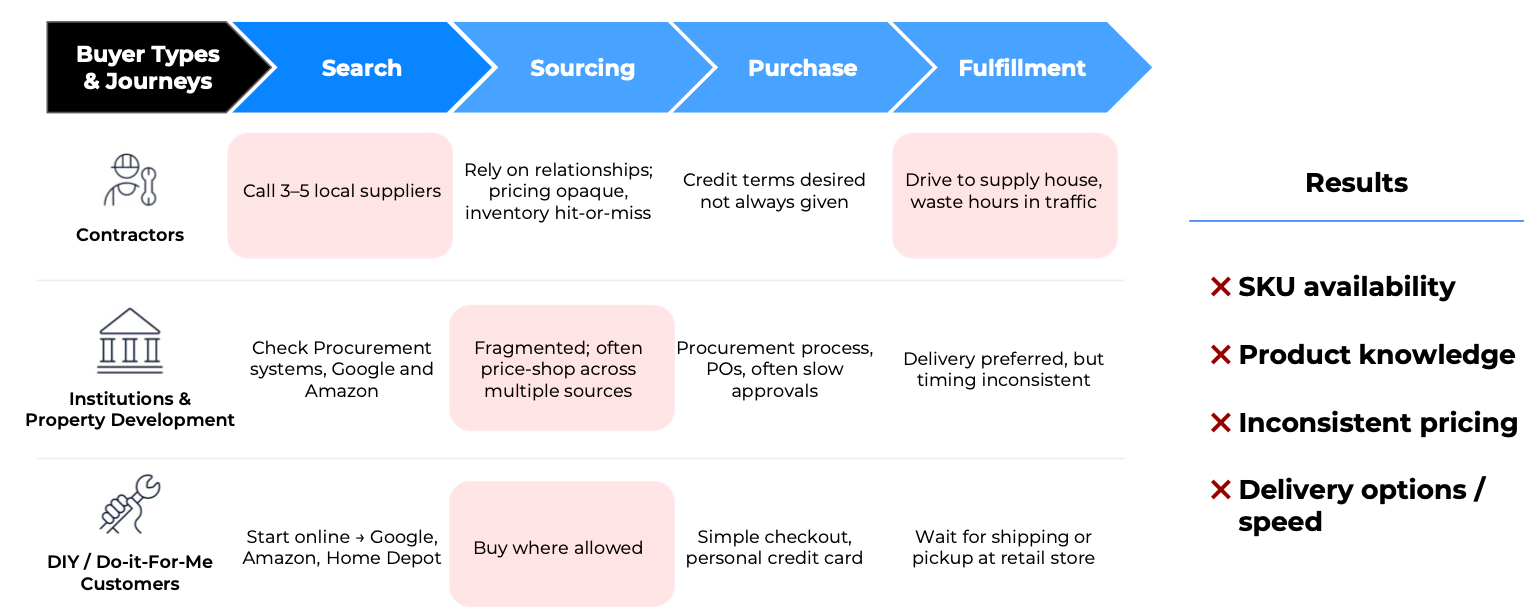
The structural advantage is straightforward to articulate: in a market where supply is fragmented across 8,000 brick-and-mortar distributors, each stocking 20,000 to 30,000 SKUs in specific geographies, the market structure rewards local knowledge. Knowing which distributor in which city has which obscure part has historically been the exclusive province of experienced sales reps with years of relationship capital. An AI-native marketplace can encode and query that local knowledge at a scale no human sales network can match. That is the core of Voomi's competitive position.
As PE ownership of HVAC contractors deepens, those operators will increasingly demand the kind of digital procurement, spend analytics, and predictive inventory tools that only an AI-native supplier can provide. Voomi's positioning becomes more valuable, not less, as industry consolidation continues.
Voomi is not an isolated bet. It is representative of a pattern we have been systematically pursuing. Across the physical economy, we look for the same set of characteristics: large, fragmented markets with high offline transaction volume; a data quality or catalog complexity problem that previously made software disruption uneconomical; an early mover with demonstrated unit economics; and a management team with both industry credibility and the operational discipline to scale a marketplace business.
We are particularly attentive to the proprietary data angle. In AI-driven marketplaces, clean, structured, proprietary data is not a feature. It is the primary source of durable competitive advantage. Companies that have invested in building high-quality data assets during the current period, when doing so is expensive and the payoff is not yet obvious to most investors, will be well-positioned as AI capabilities continue to improve.
The same consolidation wave that is reshaping the ownership structure of physical-economy businesses is simultaneously creating demand for the AI-native software and marketplace infrastructure that those businesses need to operate competitively. Companies like Voomi are positioned to serve both the fragmented legacy market and the increasingly institutional one that is emerging around it.
The digital transformation of the physical economy is not a new theme. What is new is the availability of AI tools that make it genuinely executable, cost-effectively and at scale, in industries that have resisted software disruption for decades. We believe this convergence of AI capability and offline market opportunity represents one of the most durable investment themes of the next decade.
The companies that will define this transformation share a common profile. They are building proprietary data assets today that will become more valuable as AI improves. They have demonstrated real traction in large, underpenetrated markets. And they are led by operators who understand both the technical opportunity and the industry-specific complexity that creates the moat. These businesses are harder to find than pure software companies, and harder to evaluate. That is precisely why the opportunity remains attractive.
We are actively building a portfolio around this thesis across Fund II. Voomi exemplifies exactly what we look for at Asymmetric: nuanced AI leverage, proprietary data at scale, and a clear path to durable industry transformation. We are proud to partner with RJ, the Chalofsky brothers, Operator Partners, and the entire Voomi team as they bring modern infrastructure to one of the largest offline markets remaining. It will not be the last investment of this kind we make.
This post reflects the views of the investment team and is intended for informational purposes only.


