


Compounding conviction: notes from our 2026 annual meeting
Simultaneous with the five-year anniversary of our launch, earlier this week
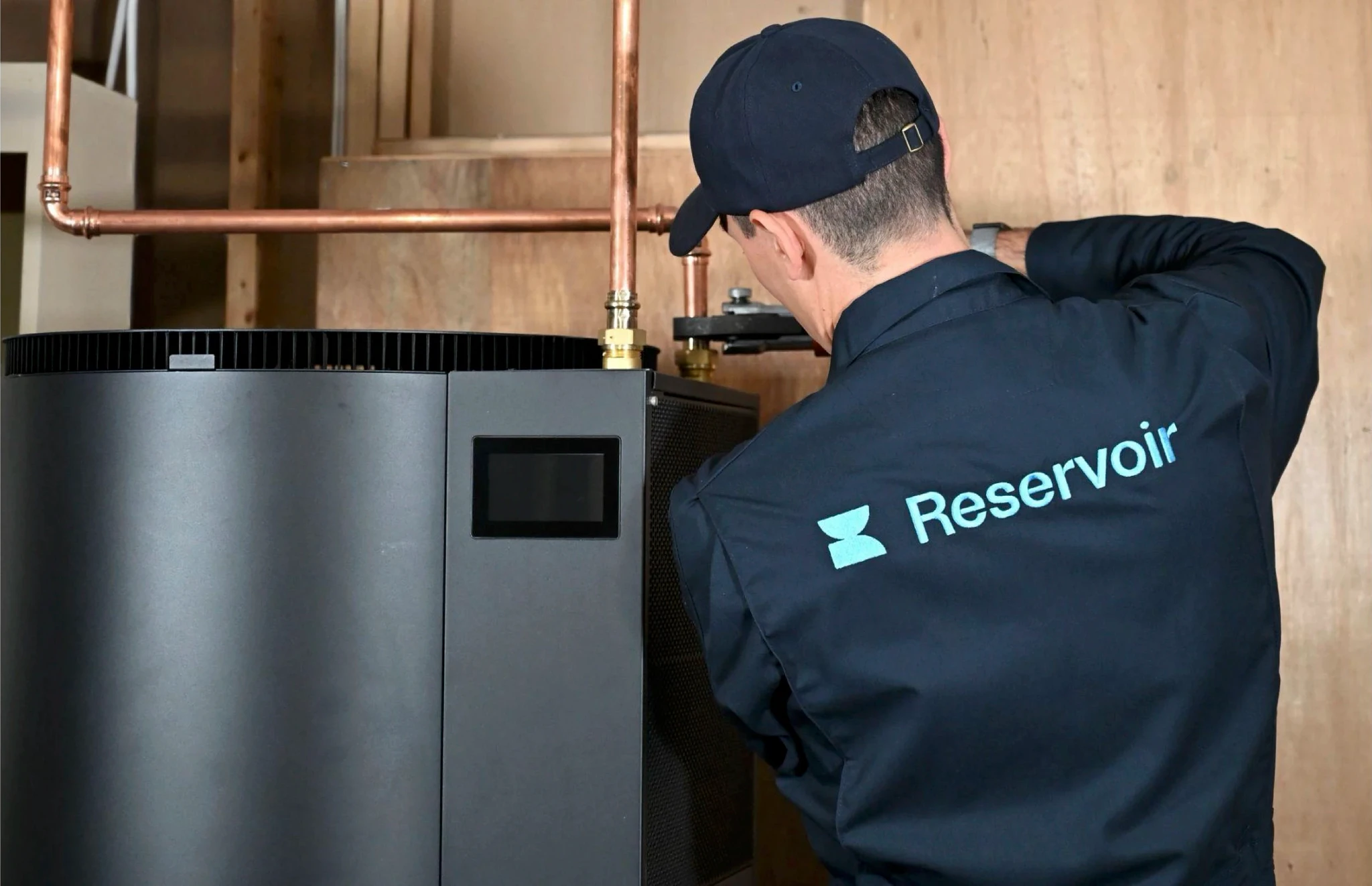
Why we led the Seed round in the company building the world's first predictive water heater; our continued pursuit of applying AI to the largest and most important markets.
We are thrilled to announce that Asymmetric led the $8 million Seed round in Reservoir, the Boston-based company making home electrification easy, affordable, and awesome, starting with hot water. We are joined by our good friends at Founder Collective, which led Reservoir's pre-seed in 2024, and MCJ.
Over the past fifteen years, nearly every fixture of the American home got smart. The thermostat became Nest. The doorbell became Ring. The garage door, the lock, the light bulb... each got an app, a brain, and a billion-dollar company built around it.
The water heater received none of this treatment. It is the second-largest use of energy in the home (a typical unit consumes more energy in a year than an electric car) and it sits in 120 million American basements in the same steel can that was in use in 1975. It heats water reactively, around the clock, whether anyone is home or not. When it fails, it fails badly: unexpected water damage accounts for 24% of home insurance claims. And the purchase itself is among the least considered in the home. A tank dies on a Tuesday morning, the homeowner calls a plumber, and by that afternoon a commodity replacement is installed from whatever was on the truck. The AI-driven disruption hitting virtually every industry every day has barely changed this one.
The market structure explains the stagnation. Roughly 10 million units are replaced in the U.S. every year, a $15 billion market and the most frequently replaced major appliance in the home, on an 8–12 year cycle. Two incumbent manufacturers dominate the market, selling steel tanks through a multi-tier wholesale distribution channel in which nobody — not the OEM, not the distributor, not the contractor — owns the relationship with the homeowner or has any incentive to make the product intelligent. It is exactly the kind of enormous, essential, structurally neglected market we spend our time looking for. It’s also one that AI and predictive analytics are about to change in a massive way.
Two technology curves are converging on this unloved appliance at once.
The first is the heat pump. Heat pump water heaters operate at roughly 400% efficiency, against 92–95% for gas and electric resistance units (physics, not marketing). Their historical weakness has been slow recovery time, which is precisely the kind of problem software solves: a predictive system that learns a household's patterns can start deliberately heating at 1am, when electricity is cheapest, so the tank is ready for the 6 am shower. Intelligence converts the heat pump's one flaw into a rounding error and its efficiency into up to $800 per year in energy savings: a very meaningful relative reduction in the total cost of ownership.
The second is the grid. Utilities are urgently seeking distributed flexibility to absorb renewable generation and manage peak load. A water heater is, quietly, a thermal battery. It can store cheap or excess energy as hot water and release it throughout the day. At scale, the country's 120 million tanks amount to a 6-billion-gallon grid-connected battery that utilities could dispatch instead of curtailing solar or building new peaker plants. Someone is going to network that asset. The incumbents, focused on their core competency of manufacturing steel cans, are not moving to do it.
Layer on electrification mandates spreading across the states, generous rebates ($1,050+ available for most homes in Massachusetts alone), and consumer energy costs that keep climbing. The window is open for a company that can actually execute across hardware, software, and the trades simultaneously.
Reservoir designs, builds, and installs its predictive water heater itself. That vertical integration is the unlock: it is why the upfront cost is comparable to traditional systems with installation included. Today Reservoir is already Massachusetts’ most affordable water heater when accounting for equipment, installation, and fuel; and it is why the company owns a customer relationship the incumbents structurally cannot. In CEO Luke Winston-Almanzar's words: "We can move faster and make better decisions because our team has experience both in the trades and in smart hardware and plumbing technology."
The execution to date backs that up. Fourteen months after closing their pre-seed, the team of eight went from capital to a fully certified product with paid installations. Reservoir has now installed heaters in nearly 100 homes across the Boston metro and heated 500,000 gallons of water since January, at unit economics that would be respectable for a software company, let alone early-stage hardware. And all of this was accomplished with extremely strong capital efficiency.
The founding team maps almost perfectly onto what this company requires. Luke was among the first business hires at Formlabs, where he helped scale a complex hardware product from Kickstarter startup to $2 billion global 3D-printing leader, and pairs that with Harvard degrees spanning chemistry and physics, business, and climate policy. CPO Gabriel Parisi-Amon worked on the iPhone supply chain at Apple before co-founding water-tech company Nebia (YC '15), which saved a billion gallons of water before its acquisition by Brondell. CTO Jake Felser worked on rocket engines at Blue Origin, robot restaurants at Eatsa, and containerized farms as CTO of Freight Farms (precisely the multi-disciplinary systems fluency that integrating heat pumps, hydronics, and machine learning demands). Go-to-market, product, and deep technical engineering: every dimension covered by someone who has done it before. Coincident with the financing, Rob will be joining the board on behalf of Asymmetric.
We would be remiss not to mention one more thing that drew us in. Plumbing faces a severe labor shortage. Only two new trades workers enter the workforce for every five who retire, and the average master plumber is nearly 60. Reservoir is pulling young people into apprenticeships by training them on smart technology, equipping them with modern tools, and giving them substantive hands-on work earlier in their careers. A company rebuilding an industry's technology while rebuilding its workforce is playing a long game we want to fund.
Reservoir fits the pattern we return to again and again at Asymmetric: (1) an enormous, non-discretionary market that technology has ignored because it was hard, physical, and unglamorous; (2) a structural shift — here, electrification and grid demand — that makes this the moment; (3) a wedge product with clear, measurable ROI for the customer from day one; and (4) operators whose lived experience spans both the technology and the industry they are transforming.
Everyone is chasing the center of the AI storm, but we see giant opportunities to deploy the technology in overlooked places like plumbing and home services. Reservoir is meeting people's everyday needs with robust technology and great service, and building a durable, compounding asset while doing it.
Hot water is the beachhead, not the destination. One hundred million water heaters will be replaced in the next decade, an infrastructure upgrade nearly every American home will make whether it wants to or not. Each Reservoir install is a lasting customer relationship, a node on a distributed grid asset, and a foothold for the broader electrified home: whole-home heating, storage, and the connected systems that will manage an ever-larger share of the country's energy consumption. The Boston playbook is built and working; this round funds its expansion in and beyond New England.
We are thrilled to partner with Luke, Gabe, Jake, and the entire Reservoir team, alongside our friends at Founder Collective and MCJ. It will not be the last investment of this kind we make.
Read the company's announcement here, and learn more at reservoirhome.com.
The views expressed here are those of the Asymmetric investment team and are for informational purposes only.


